By Eng. Suhib Jarrah | Principal Cyber Security Engineer
Wars between nations are no longer confined to geographical borders and conventional weapons. They have expanded into the digital domain, where information, ideas, and social attitudes can become instruments for achieving strategic objectives without direct military confrontation.
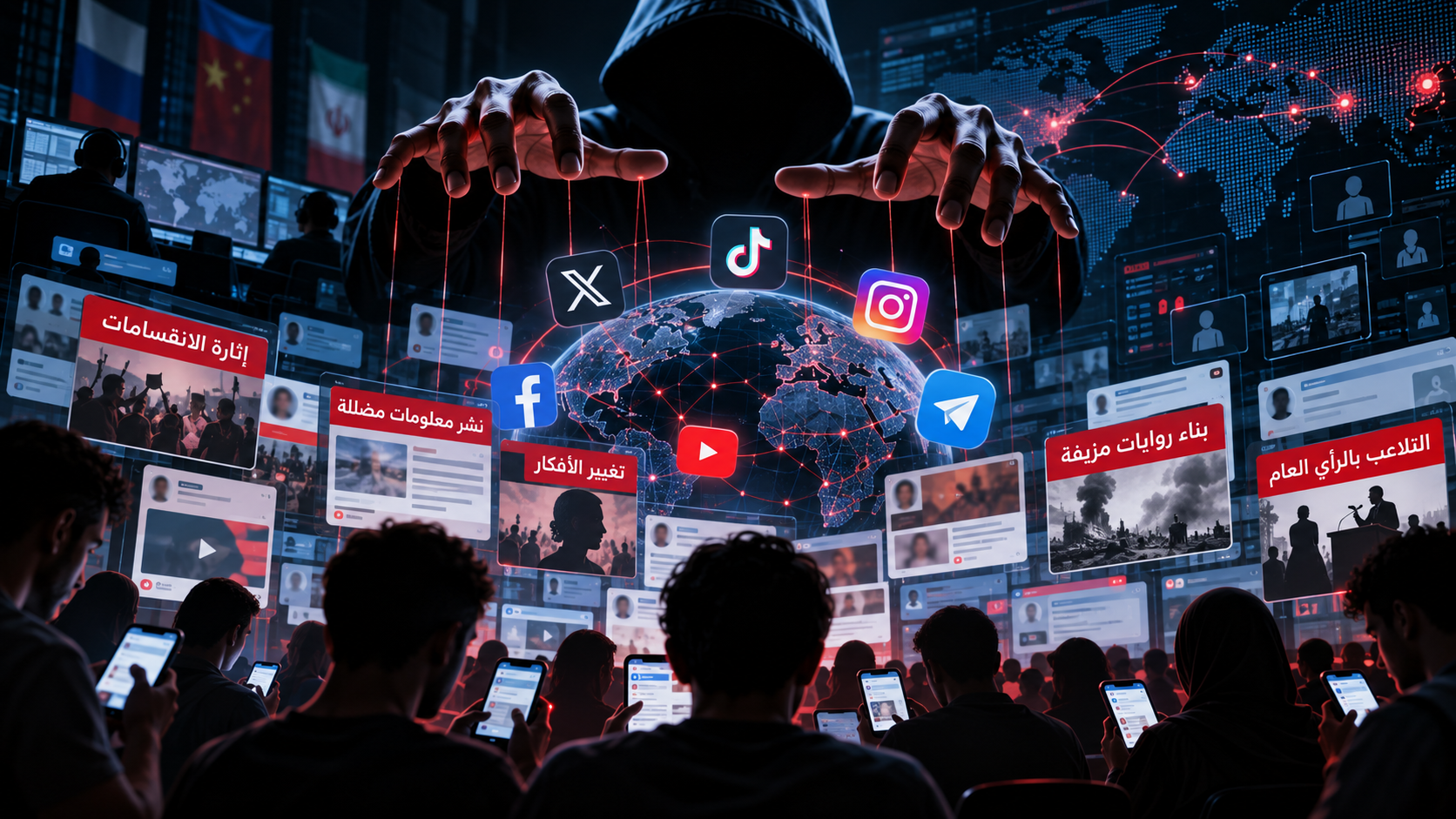
At the center of this transformation are information influence operations conducted by government entities or groups associated with them. These actors may use social media platforms to promote selected narratives, influence public opinion, and deepen divisions within societies.
The objective is not always to persuade people to adopt a new belief. Sometimes, it is to undermine trust in institutions, increase suspicion among communities, and transform ordinary disagreements into persistent conflicts and hostility.
What Are State-Backed Digital Influence Units?
These are teams or networks operating directly or indirectly in support of a state's political or strategic objectives. They may be associated with government institutions, intelligence agencies, contracted companies, or proxy organizations.
In security studies, the term Influence Operations describes activities intended to shape public perceptions and behavior.
The term Foreign Information Manipulation and Interference (FIMI) refers to intentional and coordinated activities involving deceptive or manipulative methods, potentially conducted by state or non-state actors.
It is essential to distinguish legitimate political expression, even when strongly worded, from covert operations that impersonate identities or coordinate deception to mislead the public.
How Do Influence Networks Operate on Social Media?
1. Creating Inauthentic Identities and Accounts
Some influence networks create accounts that appear to belong to ordinary citizens, activists, or independent individuals.
These accounts may initially publish everyday content to establish a digital presence before gradually becoming involved in sensitive political or social discussions.
The objective may be to make coordinated messages appear independently generated while concealing the organization behind them.
2. Amplifying Social Divisions
Influence campaigns may exploit existing social concerns, including economic inequality, political disagreements, and tensions between communities.
Such operations do not necessarily need to invent a problem. They may selectively highlight incidents, present them without sufficient context, and repeatedly promote interpretations likely to provoke anger.
Accounts associated with a campaign may even amplify opposing viewpoints simultaneously, making disagreements appear more widespread or intense than they actually are.
3. Spreading Disinformation and Manipulated Context
Not all disinformation relies on entirely fabricated stories.
A genuine statement may be presented outside its original context, an old image may be portrayed as recent, or selective facts may be shared while essential details are omitted.
This combination of factual and misleading information makes manipulation more difficult to identify, particularly when the same content is circulated across numerous accounts and pages.
4. Artificial Engagement and Coordinated Amplification
Networks of accounts may repost content and publish comments in coordinated patterns to create the impression that a particular opinion enjoys widespread support.
The danger lies in confusing artificially amplified visibility with genuine public endorsement.
However, high engagement or similar opinions alone do not prove the existence of a state-sponsored operation. Attribution requires technical investigation and multiple supporting indicators.
5. Impersonating Media Organizations and Public Figures
Fake websites or accounts may imitate established news organizations, while the identities or images of public figures may be misused to distribute fabricated statements.
As a result, misleading content originating from an unknown account may eventually be circulated by genuine users who believe it to be authentic.
Artificial Intelligence and Its Role in Information Warfare
Generative artificial intelligence has introduced additional capabilities into information manipulation and influence operations.
It is now possible to produce large volumes of text, images, audio recordings, and video content, as well as generate fictitious digital personalities that appear consistent in their communication styles and online histories.
Deepfake technology can also be used to imitate the voice of a recognizable individual or create a video suggesting that a person made statements they never actually delivered.
Microsoft's digital security reports have documented the use of artificial intelligence in influence activities associated with state-linked actors, including synthetic media and the impersonation of media personalities.
Nevertheless, the use of AI does not automatically make influence campaigns successful. High content production volumes or widespread distribution do not, by themselves, demonstrate measurable changes in public beliefs.
How Can These Operations Affect Societies?
Potential objectives vary according to the context and the actors involved. They may include:
- Undermining trust in information and public institutions.
- Intensifying existing social tensions and disagreements.
- Damaging the reputations of individuals or organizations.
- Creating misleading impressions about the popularity of certain positions.
- Influencing discussions surrounding crises and conflicts.
- Increasing confusion and making reliable information harder to distinguish from misleading content.
The consequences of some campaigns may persist even after inauthentic accounts are identified, as misleading narratives may already have spread through genuine users and other platforms.
Are There Documented Cases of These Operations?
Yes. Technology companies, research organizations, and public institutions have documented coordinated information manipulation networks, some of which have been attributed to state-linked actors.
In its fourth report published in March 2026, the European External Action Service (EEAS) reported identifying 540 incidents of foreign information manipulation and interference during the period covered by its analysis. The report also described the use of thousands of channels and websites to distribute or amplify content.
Meta has likewise published investigations into Coordinated Inauthentic Behavior (CIB), including networks that use fabricated identities and artificial engagement to influence online discussions.
These findings demonstrate the existence of a documented threat. However, they do not justify accusing any particular account, organization, or country without specific and verifiable evidence.
How Can Coordinated Influence Campaigns Be Detected?
Investigating such operations requires a combination of Open-Source Intelligence (OSINT), network analysis, digital behavioral analysis, and content verification.
Important indicators to examine include:
1. Unusual Similarities in Posting Activity
Identical or highly similar messages appearing across multiple accounts within closely overlapping time periods.
2. Artificial Engagement Patterns
Groups of accounts repeatedly sharing the same messages or interacting with one another through unusual, coordinated patterns.
3. Unreliable Digital Identities
AI-generated profile images, contradictory biographical information, or impersonation of individuals and organizations.
4. Interconnected Sources and Websites
Content repeatedly circulating among apparently independent pages or websites that may share technical infrastructure or operational connections.
5. Context Manipulation
Outdated, edited, or falsely attributed material being presented to support misleading narratives.
No single indicator is sufficient to establish the existence of a coordinated manipulation network. Professional analysis requires multiple sources of evidence, consideration of alternative explanations, and a clear distinction between inauthentic coordination and legitimate collective activity.
How Can Societies Protect Themselves Against Digital Manipulation?
Effective protection begins with digital awareness rather than the surveillance of opinions or the suppression of disagreement.
Important preventive practices include:
- Verify the original source of information before sharing it.
- Check the publication date and context of images and videos.
- Do not assume that large numbers of likes or comments indicate accuracy.
- Be cautious of posts that exploit fear or intense anger to encourage immediate sharing.
- Compare important claims with independent and credible sources.
- Use reporting mechanisms for identity impersonation and coordinated manipulation.
- Support media literacy and critical thinking.
At the institutional level, cybersecurity and digital intelligence teams can help identify organized campaigns, examine their sources, and assess their impact while respecting privacy, freedom of expression, and applicable legal protections.
Conclusion
Social media platforms have become environments in which organized information influence operations may be conducted to advance political and strategic interests, including campaigns associated with states or organizations acting on their behalf.
The danger does not lie in a single misleading statement. Rather, it lies in the potential use of interconnected accounts, websites, and synthetic media to create distorted perceptions of reality and intensify social divisions.
Protecting society against information warfare does not mean preventing differences of opinion. It means protecting people's ability to form independent judgments based on accurate information, transparent sources, and freedom from coordinated deception.
Cybersecurity today is no longer limited to protecting devices, networks, and data. It also involves understanding threats to information integrity, digital trust, and the reliability of the online environment.
References and Sources
This article draws on published reports and research from organizations specializing in digital security and information manipulation:
-
European External Action Service (EEAS)
Information Integrity and Countering Foreign Information Manipulation and Interference (FIMI).
Read the official resource -
EEAS — 4th FIMI Threat Report (2026)
The fourth report on foreign information manipulation and interference threats.
Read the report -
Microsoft Digital Defense Report 2025
Research on digital threats and cyber activities associated with state-linked actors.
Read the report -
Meta — Coordinated Inauthentic Behavior Research
Technical investigations into inauthentic account networks and coordinated influence activities.
Read the investigation