By Eng. Suhib Al Jarrah | Principal Cyber Security Engineer
Introduction: When a Daily Snap Becomes a Digital Security Risk
Social media platforms have become an integral part of everyday life. Sharing photos and videos is no longer simply a way to communicate; it has evolved into a repeated social behavior driven by habits, engagement, and the desire to maintain digital relationships.
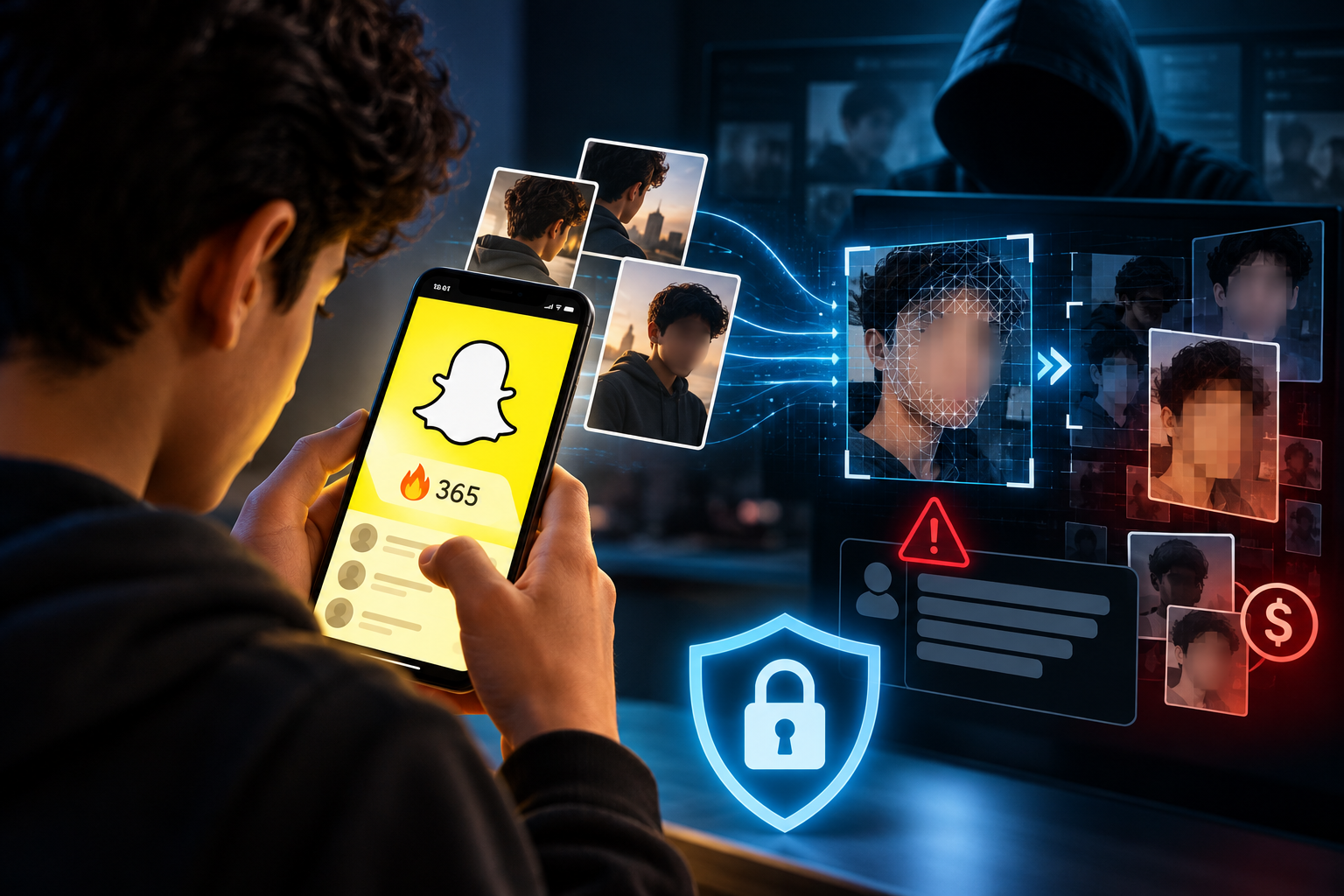
One prominent example is Snapchat's Snapstreak feature, which encourages users to exchange photo or video Snaps daily to maintain an uninterrupted streak.
Although sending a daily photo may appear harmless, advancements in Generative Artificial Intelligence (Generative AI), facial manipulation, and deepfake technologies have introduced new privacy and security risks.
Personal photographs can potentially be misused to create fabricated content, impersonate identities, damage reputations, or facilitate cyber extortion.
This raises an important question: Do Snapchat users fully understand how the photos they share today might be exploited in the future?
1. What Are Snapchat Streaks?
Snapstreaks are a Snapchat feature that tracks consecutive days during which two users exchange qualifying photo or video Snaps. A flame symbol appears next to the conversation, accompanied by the number of consecutive days.
Over time, maintaining a streak can become a perceived social obligation. Some users feel pressured to send photos every day, even when there is no meaningful reason to communicate, simply to avoid losing their accumulated streak.
The security concern does not originate from the Snapstreak feature itself. Using Snapchat does not automatically expose someone to hacking or extortion.
Rather, the risk emerges when users repeatedly share personal images without carefully considering the identity, intentions, and trustworthiness of their recipients.
2. Why Can Everyday Photos Become Sensitive Information?
When individuals share photographs regularly, they may gradually expose personal information that seems insignificant when viewed in isolation.
These images may reveal facial features from multiple angles, details of a home, educational institutions, workplaces, school uniforms, family members, friends, or elements of daily routines.
Over time, a collection of photographs can provide a more comprehensive understanding of a person's identity, surroundings, relationships, and habits.
When combined with publicly available information from social media profiles, these details may increase the potential for identity impersonation, social engineering, and targeted harassment.
Importantly, such misuse does not necessarily require hacking a Snapchat account.
An individual who legitimately receives photographs may later misuse them, retain copies, or distribute them without the sender's permission.
3. Do Disappearing Snapchat Photos Guarantee Privacy?
Snapchat provides features designed to delete many messages and Snaps after they have been viewed or after specified retention periods, subject to the platform's settings and policies.
However, disappearing content should never be interpreted as an absolute guarantee that a photograph cannot be retained.
Recipients may be able to save certain content using available application features, capture screenshots, or photograph the display using another device.
Therefore, a photograph disappearing from a conversation does not necessarily mean that every copy of it has ceased to exist.
It is essential to distinguish between the security controls provided by the platform and the behavior of the individuals who receive personal content.
Security features can reduce risks, but they cannot guarantee that every recipient will respect the sender's privacy.
4. How Artificial Intelligence Has Changed the Threat Landscape
Historically, the misuse of personal photographs often involved unauthorized sharing or editing through conventional image manipulation software.
Today, Generative AI and deepfake technologies can produce synthetic photographs and videos with varying levels of realism.
This technological development has expanded the potential for image-based abuse.
4.1 Facial Manipulation and Identity Replication
A clear photograph of a person's face may be used as reference material to generate synthetic imagery or place their likeness into scenes in which they never appeared.
The quality and credibility of these outputs depend on the available source images, the technology employed, and other technical factors.
4.2 Fabricated Sensitive or Intimate Images
Some image-generation or editing technologies can be misused to create fabricated images depicting individuals in embarrassing, compromising, or intimate situations that never occurred.
This form of non-consensual image manipulation represents a serious violation of personal privacy and dignity.
Even when the victim knows the material is fabricated, the fear of public exposure, reputational damage, or misunderstanding can cause substantial psychological distress.
4.3 Digital Identity Impersonation
Real or AI-manipulated photographs may be used to create fraudulent social media accounts that impersonate a victim.
Such accounts can be exploited to deceive friends, family members, colleagues, or other individuals into trusting fraudulent communications.
4.4 AI-Generated Video Manipulation
Artificial intelligence can also be used to generate misleading videos that falsely associate individuals with statements, actions, or events that never happened.
Consequently, apparently realistic visual content should not automatically be accepted as authentic evidence.
5. How Personal Photos Can Be Exploited for Cyber Extortion
One possible exploitation scenario begins with an individual establishing trust through a social media relationship.
Daily communication and repeated photo exchanges may gradually create a sense of familiarity and emotional trust.
After obtaining clear photographs or learning about the user's personal relationships, a malicious individual may threaten to misuse the collected material.
The attacker may claim to possess sensitive photographs or videos, present AI-generated fabricated content, or threaten to distribute misleading images to the victim's relatives, friends, or colleagues.
Such threats may be accompanied by demands for money, additional photographs, or other forms of compliance.
Crucially, the original photographs do not have to contain anything sensitive.
In some cases, an ordinary portrait may be manipulated to create fabricated compromising content.
The central objective of the extortionist is often to exploit fear, uncertainty, and concern about reputation.
A fabricated image is not proof that the depicted event occurred. Likewise, voluntarily sharing a normal photograph does not authorize anyone to manipulate, distribute, or exploit it.
6. Why Children and Teenagers Face Particular Risks
Children and teenagers may associate maintaining a Snapstreak with friendship, social acceptance, or relationship stability.
This perception can encourage repeated image sharing without sufficient consideration of privacy implications.
A malicious individual may exploit this dynamic to build trust gradually, gather personal information, or pressure a young person into sharing increasingly private content.
Another significant concern is that young victims may hesitate to report threats because they fear punishment, embarrassment, or negative reactions from their families.
Parents and educators should therefore establish open communication, explain digital privacy risks, and encourage young people to seek assistance immediately when they feel uncomfortable or threatened.
Victims of online extortion deserve protection and support, not blame.
7. Does Every Snapchat Streak Create an Extortion Risk?
No. Maintaining a Snapstreak does not automatically lead to cyber extortion, and there is no basis for claiming that every photo shared on Snapchat is automatically transferred to malicious AI systems.
The level of risk depends on several factors, including the nature of the shared content, the recipient's identity, the level of trust involved, the possible existence of retained copies, and the availability of additional identifying information.
The purpose of cybersecurity awareness is to reduce foreseeable risks rather than create unnecessary fear about technology.
8. Practical Measures to Protect Your Digital Privacy
- Limit unnecessary facial photo sharing: Do not feel obligated to send clear personal photographs daily, especially to individuals you do not know well.
- Avoid exposing sensitive information: Keep identity documents, home addresses, school uniforms, workplace details, and private family information out of shared images.
- Review your friends list: Remove unfamiliar or suspicious accounts and reconsider unnecessary connections.
- Strengthen privacy settings: Control who can contact you, view your stories, and access location-related information.
- Understand the limitations of disappearing messages: Assume that recipients may retain copies of shared material.
- Recognize manipulation and pressure: Be cautious when someone repeatedly demands personal images or attempts to create emotional pressure.
- Secure your account: Use a strong, unique password, enable two-factor authentication, and review connected devices and active sessions.
- Educate children and teenagers: Discuss online privacy, image manipulation, and safe reporting procedures without creating fear or shame.
9. What Should You Do If Someone Threatens You With Real or AI-Manipulated Images?
If an individual threatens to distribute personal or manipulated photographs, treat the situation as a serious security incident.
- Do not pay or comply with demands: Sending money or additional photographs does not guarantee that the threats will stop.
- Preserve evidence: Document threatening messages, account names, relevant URLs, timestamps, and payment requests without unnecessarily redistributing sensitive material.
- Avoid prolonged negotiations: After preserving available evidence, stop engaging with the extortionist and block the offending account.
- Report the account to Snapchat: Use the platform's reporting mechanisms for harassment, impersonation, and non-consensual intimate content.
- Contact the relevant authorities: In Saudi Arabia, cybercrime incidents can be reported through official security reporting channels, including applicable services within the Kollona Amn application.
- Seek support: Speak with a trusted person. Children and teenagers should involve a trusted adult or appropriate protection authority as soon as possible.
- Secure compromised accounts: If account intrusion is suspected, change passwords, review recovery options, and examine active sessions.
Specialized services may also help limit the spread of certain non-consensual intimate images.
StopNCII.org provides assistance for eligible adults, while TakeItDown.NCMEC.org provides a service for qualifying content involving individuals who were under 18 when the imagery was created.
Each service has its own eligibility requirements and operational limitations.
10. The Responsibility of Families and Educational Institutions
Cybersecurity awareness should no longer focus exclusively on passwords, suspicious links, and malicious applications.
Modern awareness programs must also address digital identity protection, image-based abuse, AI-generated deception, and the responsible sharing of personal content.
Schools, universities, and community organizations should educate students about the consequences of unauthorized image manipulation and explain how to recognize and report cyber extortion.
Educational programs must also emphasize that redistributing fabricated images or mocking victims can amplify harm, even when the person sharing the material did not originally create it.
11. Digital Identity Protection: A Growing Cybersecurity Priority
Artificial intelligence is expanding the traditional boundaries of cybersecurity.
Protecting digital identities now requires more than securing devices, networks, applications, and user accounts.
Personal photographs, online relationships, behavioral patterns, and publicly accessible information can collectively form a digital identity that malicious individuals may attempt to exploit.
This creates a need for a more comprehensive approach to personal data protection.
Individuals should consider not only what they share, but also who receives it, how it might be retained, and how it could be reused beyond the original context.
Cybersecurity awareness must therefore include the entire lifecycle of personal information, from initial sharing to potential misuse and incident response.
Conclusion: Your Privacy Is More Important Than Any Snapchat Streak
The objective of this article is not to discourage the use of Snapchat or other social media platforms.
Instead, it is to highlight how emerging artificial intelligence technologies have changed the potential consequences of sharing personal photographs online.
Images that once appeared harmless may become useful material for identity impersonation, fabricated content, reputational attacks, or cyber extortion when they are obtained by malicious individuals.
Digital trust should never mean abandoning basic privacy principles.
Remember: A photograph shared today may remain beyond your control tomorrow. The Snapchat Streak you are afraid of losing is far less valuable than your privacy, reputation, and digital safety.
Eng. Suhib Al Jarrah
Principal Cyber Security Engineer
suhibjarrah.com