Phishing Attacks: Common Techniques, Risks, and How to Protect Yourself
By Eng. Suhib Jarrah | Principal Cyber Security Engineer
With the rapid expansion of digital services and the growing reliance on the internet for banking, communication, and business operations, cyberattacks no longer depend exclusively on exploiting complex technical vulnerabilities. Instead, attackers increasingly target one of the most influential elements of any security environment: human behavior.
Phishing is among the most prevalent forms of cyberattack, exploiting trust, fear, urgency, and curiosity to persuade victims to take unsafe actions, such as revealing passwords, sharing verification codes, transferring funds, or installing malicious software.
The danger of phishing lies in its ability to bypass security controls indirectly. Rather than breaking into a system through a software vulnerability, attackers may convince legitimate users to perform the very actions that grant unauthorized access.
As artificial intelligence technologies advance, phishing campaigns have also become more convincing in terms of language, design, and impersonation, making detection increasingly challenging for both individuals and organizations.
1. What Is Phishing?
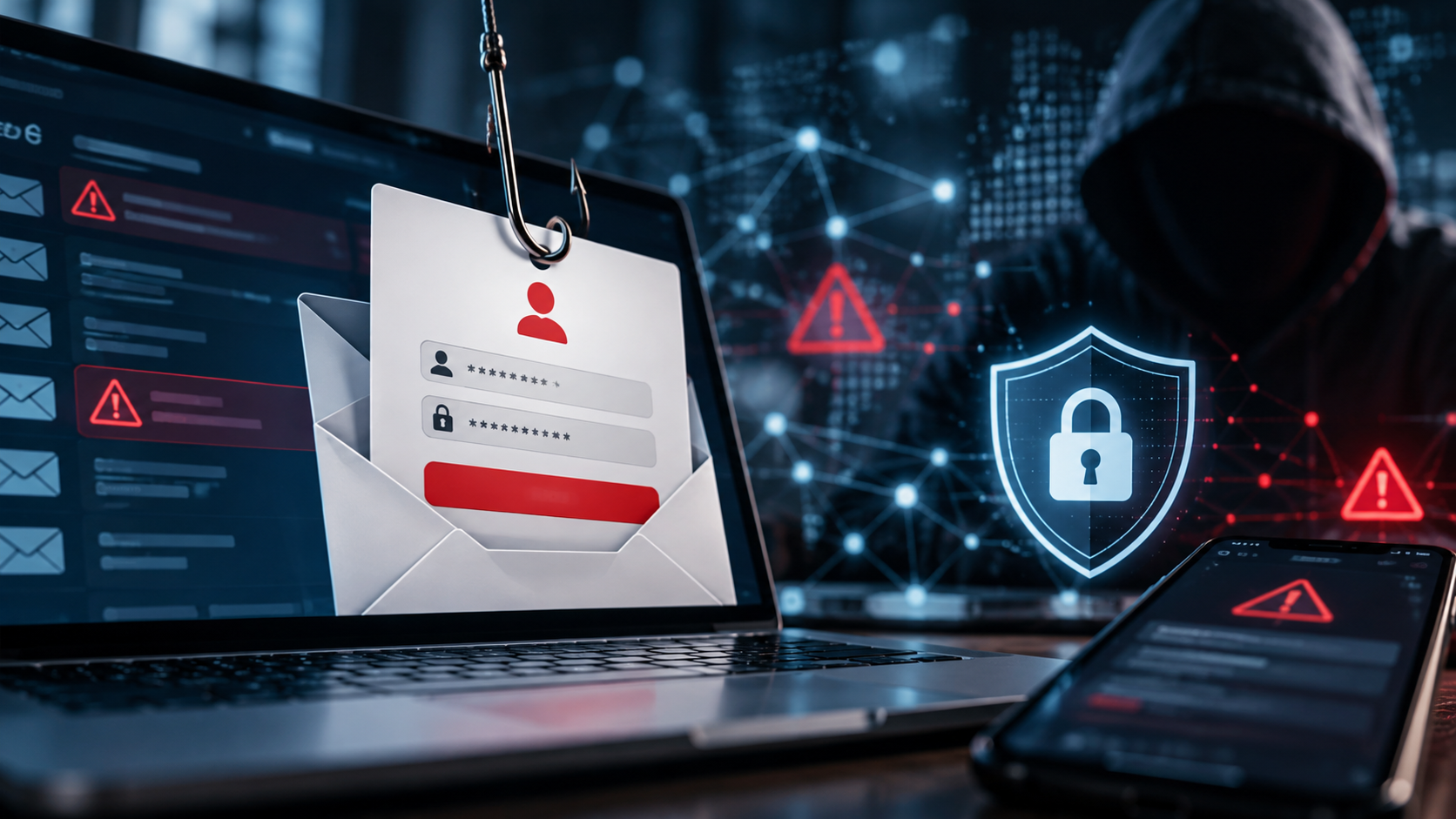
Phishing is a form of social engineering in which attackers impersonate trusted organizations or individuals to obtain sensitive information or manipulate victims into performing actions that benefit the attacker.
Attackers may impersonate banks, telecommunications providers, government agencies, delivery companies, technical support teams, or executives within an organization.
Phishing attempts can be delivered through email, text messages, messaging applications, telephone calls, or fraudulent websites.
For example, a user might receive a message claiming that their bank account requires immediate verification. The message directs them to a website that closely resembles the bank's official website but is actually designed to collect their credentials.
The attacker's objective is not necessarily to compromise a system technically, but to persuade a legitimate user to surrender information, authorization, or access through deception.
2. Why Is Phishing Such a Serious Cybersecurity Threat?
Phishing is dangerous because it can be adapted to different environments, industries, and target groups.
An attacker may not need to discover an operating system vulnerability or bypass a firewall. A convincing message may be enough to obtain the credentials of a user with privileged access.
The primary risks include:
Account compromise: Stealing passwords or verification codes to gain unauthorized access.
Financial losses: Deceiving victims into transferring money or disclosing payment information.
Corporate compromise: Taking over employee accounts to access email, cloud services, files, or internal systems.
Data theft: Obtaining personal, confidential, or commercially sensitive information.
Malware infections: Persuading victims to open malicious files or install untrusted applications.
Cyber extortion: Using stolen information or compromised accounts to threaten individuals or businesses.
Reputational damage: Impersonating organizations and sending fraudulent communications in their name.
The impact may become significantly more severe when compromised accounts are connected to multiple enterprise systems or possess administrative privileges.
3. Common Types of Phishing Attacks
3.1 Email Phishing
Email remains one of the most widely used channels for phishing.
Attackers send messages that appear to originate from legitimate organizations, often incorporating familiar logos, branding, formatting, and communication styles.
Messages may claim that an invoice is overdue, an account has been suspended, a password must be updated, or an important document requires immediate attention.
They frequently include a link to a fraudulent website or an attachment containing potentially malicious content.
Example: A message claims that a cloud service subscription will expire within hours unless the recipient updates their payment details.
A professional appearance does not establish authenticity. Logos, images, visible sender names, and certain email headers can be imitated or manipulated.
3.2 Spear Phishing
Unlike mass phishing campaigns, spear phishing targets specific individuals or groups using information intended to make the communication more credible.
Attackers may research publicly available information about a target's position, employer, colleagues, responsibilities, or ongoing projects.
They then craft messages that appear relevant to the recipient's actual work.
For example, an employee might receive what appears to be an internal message concerning a project they are currently involved in.
The more closely an email matches a real business context, the more likely the recipient may be to regard it as legitimate.
3.3 Whaling
Whaling is a specialized form of phishing targeting executives, senior management, and other individuals with significant authority or access to sensitive information.
Messages may involve confidential agreements, urgent payment approvals, legal documents, or executive-level instructions.
The risk is particularly significant because the targeted individuals may have access to high-value information or financial approval processes.
A single compromised executive account can therefore create consequences extending well beyond the individual account.
3.4 Business Email Compromise (BEC)
Business Email Compromise refers to fraudulent activities that exploit email communications or impersonate business identities to initiate financial transactions or obtain sensitive information.
For example, an attacker may impersonate a supplier or finance manager and request that outstanding invoices be paid into a different bank account.
Unlike traditional phishing, a BEC message may contain no malicious attachment or suspicious link. It may consist entirely of convincing financial instructions.
This makes BEC particularly challenging for security systems that focus primarily on scanning URLs and attachments.
Changes to bank account information should always be verified through an independently established and trusted communication channel.
3.5 SMS Phishing (Smishing)
Smishing uses text messages to deliver deceptive communications that appear to originate from trusted services.
Common themes include delayed shipments, unpaid delivery charges, utility bills, account verification, or banking notifications.
The message may direct users to a fraudulent payment page or login form.
On mobile devices, identifying suspicious destinations can be more difficult because URLs and security details may not be fully visible on smaller screens.
3.6 Voice Phishing (Vishing)
Vishing involves telephone-based social engineering.
Attackers may impersonate bank employees, technical support staff, government representatives, or internal company personnel.
They attempt to obtain sensitive information or convince victims to complete unauthorized actions.
Some attacks use psychological pressure, such as claiming that suspicious financial activity must be stopped immediately.
A familiar or apparently official caller ID does not guarantee that a call is legitimate, because caller identification information can be spoofed under certain circumstances.
3.7 QR Code Phishing (Quishing)
As QR codes become increasingly common in restaurants, parking services, government systems, and commercial transactions, they also create opportunities for phishing.
An attacker might place a fraudulent QR code over a legitimate one or distribute QR codes through deceptive messages.
Scanning the code may direct the user to a counterfeit website designed to collect credentials or payment information.
The QR code itself is not inherently malicious. The risk lies in the destination and the actions the user is asked to perform.
Users should verify website addresses before opening them and avoid entering sensitive information on pages reached through untrusted QR codes.
3.8 Phishing Through Messaging Applications and Social Media
Messaging platforms such as WhatsApp, Telegram, and social networks are also used to distribute fraudulent messages.
Sometimes the message originates from an account that has already been compromised, making it appear more credible.
Attackers may request urgent financial assistance, verification codes, participation in online competitions, or access to documents and login pages.
Because the sender may appear to be a trusted friend, colleague, or organization, these attacks can be particularly persuasive.
3.9 Search Engine and Advertising-Based Phishing
Attackers may create counterfeit websites and attempt to attract visitors through search results or paid advertisements.
A user searching for an official login page may click a result that appears authentic but leads to a different domain displaying a convincing imitation.
A prominent position in search results or a sponsored advertisement does not establish the legitimacy of a website.
For sensitive services, users should rely on known official domains, verified applications, or previously saved trusted links.
3.10 OAuth Consent Phishing
OAuth consent phishing targets authorization workflows rather than directly stealing passwords.
An attacker may convince a user to approve access requested by an untrusted third-party application.
The authorization screen itself may be genuine and provided by a legitimate identity platform, while the requesting application is malicious.
Depending on the permissions granted, the application may gain access to email, files, profile information, or other account resources.
This technique is dangerous because it can provide access to sensitive data without requiring the attacker to obtain the user's password.
Organizations should restrict unnecessary application permissions, manage consent policies, and regularly review third-party application access.
4. How Artificial Intelligence Is Changing Phishing Attacks
Advances in generative artificial intelligence have made it easier to produce convincing phishing messages with fluent language and contextually relevant details.
AI-powered tools can also generate synthetic images, voices, and videos that facilitate impersonation.
Common Applications of AI in Phishing
Personalized messages: Generating communications tailored to the recipient's language, profession, and business environment.
Writing style imitation: Producing text that resembles the communication style of a colleague, executive, or organization.
Voice impersonation: Using synthesized or cloned voices in fraudulent telephone interactions.
Deepfake content: Creating misleading audio or video that appears to show a known individual giving instructions.
Automated deceptive interactions: Using conversational systems to respond to victims during fraudulent exchanges.
However, the capabilities of these technologies should not be exaggerated. Not every synthetic voice is indistinguishable from the original, and impersonation attempts are not universally successful.
Nevertheless, these technologies reduce the reliability of traditional warning signs such as poor grammar or unprofessional presentation.
5. How Can a Phishing Email Lead to an Enterprise Security Incident?
A phishing incident may begin with a message impersonating a trusted enterprise service.
If the recipient enters credentials into a fraudulent login page, the attacker may obtain authentication information that could be exploited, depending on the security controls in place.
The attacker may subsequently attempt to access email, cloud services, or other resources associated with the compromised account.
In other cases, opening a malicious attachment or approving an untrusted application may expose information or create additional security risks.
However, successful phishing does not automatically mean that an entire corporate network has been compromised.
The outcome depends on account privileges, authentication policies, system segmentation, session monitoring, and the effectiveness of additional security controls.
This demonstrates the importance of Least Privilege and Zero Trust principles, which reduce the likelihood that compromising one identity will grant broad access to critical systems.
6. Why Multi-Factor Authentication Is Not Always Enough
Multi-factor authentication (MFA) is an essential defense against account compromise, but not all authentication methods provide the same protection against phishing.
Attackers may attempt to trick users into sharing temporary authentication codes or approving unexpected login requests.
Other attacks may target session tokens or misuse consent granted to third-party applications, depending on the authentication technology and application environment.
Whenever available, organizations should adopt phishing-resistant authentication methods such as security keys and FIDO2/WebAuthn.
These technologies help bind authentication to the legitimate website and reduce the effectiveness of credential-harvesting websites.
Nevertheless, device security, session protection, and access governance remain necessary even when strong authentication methods are deployed.
7. Warning Signs of Phishing Attempts
Although phishing techniques are becoming more sophisticated, certain indicators should trigger additional scrutiny:
Messages demanding immediate action under the threat of account suspension.
Requests to disclose passwords or verification codes.
Website domains that differ from the organization's official domain.
Requests to change bank account details solely through email.
Unexpected attachments or instructions to install unknown applications.
Third-party applications requesting excessive permissions.
Unusual financial instructions allegedly originating from executives.
Psychological pressure intended to discourage independent verification.
The absence of these warning signs does not necessarily mean a message is legitimate. Some phishing attempts are highly sophisticated and contain few obvious mistakes.
8. How Individuals Can Protect Themselves
Effective protection begins with treating unexpected requests involving sensitive information as communications that require independent verification.
Recommended security practices include:
Verify the source: Visit official websites directly rather than relying on links in unexpected messages.
Never share verification codes: Authentication codes should not be disclosed to third parties.
Use strong authentication: Enable passkeys or phishing-resistant security keys whenever available.
Examine website addresses: Confirm the actual domain before entering credentials.
Keep devices updated: Install security updates for operating systems, browsers, and applications.
Be cautious with attachments: Verify unexpected files before opening them.
Review application permissions: Avoid granting unnecessary access to email, documents, or other sensitive resources.
Verify financial instructions independently: Confirm unusual payment requests through previously established contact details.
9. How Organizations Can Defend Against Phishing
Organizations require a layered cybersecurity strategy combining technical safeguards, awareness, governance, monitoring, and incident response.
Email Security
Correctly configured SPF, DKIM, and DMARC controls help reduce certain forms of email-domain spoofing.
Email security gateways can also evaluate suspicious attachments, links, and messages.
However, these controls do not necessarily prevent fraudulent communications originating from legitimate accounts that have already been compromised.
Identity and Access Management
Organizations should adopt phishing-resistant authentication for sensitive accounts, enforce Least Privilege, implement Conditional Access, and regularly review third-party application permissions.
Endpoint Protection
Endpoint Detection and Response (EDR), device monitoring, timely software updates, and application control can reduce the impact of phishing incidents involving malware.
Security Monitoring and Incident Response
Security Information and Event Management (SIEM) platforms can correlate identity, email, and endpoint events to help identify suspicious patterns.
Examples include unusual login attempts, unexpected account configuration changes, and abnormal access activities.
Security Awareness
Awareness programs, practical training, and authorized phishing simulations can help employees recognize and report suspicious communications.
However, cybersecurity awareness should not become a mechanism for assigning all responsibility to individual employees.
Organizations must also design resilient systems and controls that limit the impact of human error.
10. What Should You Do If You Fall Victim to Phishing?
The appropriate response depends on the type of information exposed and the actions performed during the incident.
If you entered your password on a fraudulent website, immediately change it using the official service from a trusted device. Review active sessions and account recovery settings.
If you shared a verification code or approved an unexpected login request, inspect account activity and revoke suspicious sessions or permissions.
If you installed an untrusted application or opened a potentially malicious file, evaluate the security of the device before continuing to use sensitive services.
If financial details were exposed or unauthorized transactions occurred, contact the relevant financial institution immediately to report the incident and initiate protective measures.
Enterprise Incident Response
Employees should promptly report suspected phishing incidents to the organization's cybersecurity team or Security Operations Center (SOC).
Relevant emails, event logs, timestamps, and other evidence should be preserved.
Depending on the incident, response measures may include revoking active sessions, disabling compromised credentials, reviewing application permissions, isolating affected devices, and investigating unauthorized data access.
Early reporting and response can significantly reduce the potential impact of a phishing incident.
11. Can Phishing Be Eliminated Completely?
It is unrealistic to assume that every phishing attempt can be prevented through a single security tool.
Threat actors continually adapt their techniques, combining impersonation, social engineering, and publicly available information about their targets.
The most effective strategy is to reduce the likelihood of successful deception, limit the privileges available to a compromised identity, and improve the organization's ability to detect and respond to suspicious activities.
Cybersecurity should therefore be approached as an integrated discipline encompassing people, processes, technology, and governance.
Conclusion: People Are Not the Only Line of Defense
Phishing demonstrates that a cybersecurity incident does not always begin with a software vulnerability. It may begin with a convincing email, a fraudulent telephone call, or an apparently legitimate request.
However, the success of these attacks does not depend exclusively on the behavior of the targeted user.
It is also influenced by system architecture, authentication mechanisms, identity governance, security monitoring, and the organization's ability to detect and contain threats.
As artificial intelligence and deepfake technologies continue to evolve, individuals and organizations must move beyond trusting the appearance of messages, voices, and websites toward independent verification of identities, instructions, and access permissions.
The strongest defense against phishing is not simply recognizing fraudulent messages, but building a security environment in which deception is harder to exploit and its consequences are limited even when an attack succeeds.
Technical References
Eng. Suhib Jarrah
Principal Cyber Security Engineer
https://suhibjarrah.com